

Productivity study proves unproductive

I have just completed a three-year study of New Zealand’s productivity.
It began when I moved into my apartment on the 31st level of a Downtown Auckland tower block which affords a sweeping bird’s eye view of all the goings-on in the throbbing heart of our largest city. It’s not all gunfights and homeless people down here, you know. The view from above is a total revelation.
For a start, I was blown away by how quickly the departed office workers had been replaced by people in fluoro jackets, and how many of those people spent their days on roof tops. I’m lucky to be on level 31 because it allows me to look down on it all without constantly reaching for binoculars. If I’d had more money than sense I could have purchased up to twenty levels higher in the building, but you need the eyesight of a gannet up there. The ambulance driver the other day asked me if I got vertigo, and I replied that it was my plummeting blood pressure that made me dizzy, not height. I’m told, however, that a lot of people with more money than sense do suffer from vertigo.
You wouldn’t know it from the GDP stats, but there’s an awful lot happening in Auckland. Pavements are being ripped up, shops are being gutted, bicycle lanes are being filled with concrete planter boxes, and the roads are being painted green so that Auckland Transport can take their empty buses for test runs on them.
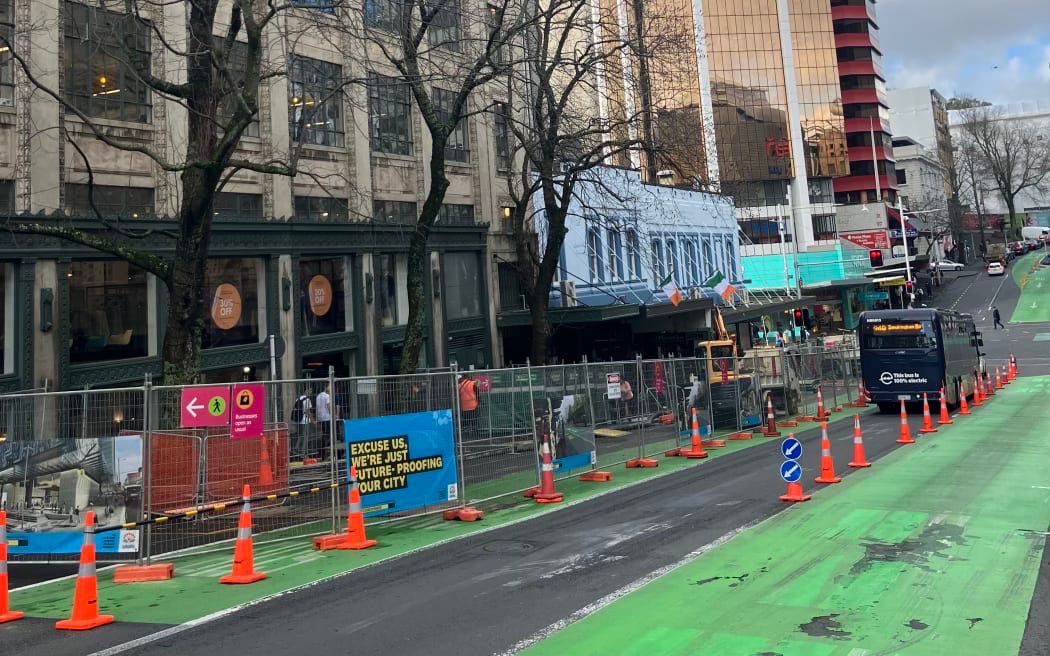
But the real action is up top. Daytime Roof Dwellers is a demographic that one doesn’t hear about very often, and I have to admit it was a surprise to me when I discovered it. At first, I thought it must be something to do with air conditioning units from the 1980s all failing at once, but a closer examination proved this to be only partially true. Clearly there were other things going on, and I determined to get to the bottom of it. That was what led me into my three-year productivity study.
It started with the building immediately opposite mine. One day our street was blocked by a big truck unloading orange safety cones. The cones were carefully spread out over the next few hours by two people in orange jackets so that they effectively blocked access to the traffic lights and sealed off the bus stop. The next day a large crane was parked in the street, protected by those orange cones, and the day after it was joined by a flat-bed truck with pallet loads of scaffolding on the back. Needless to say, my attention was aroused, not least by the fact that it had become impossible to exit from my building’s car park without reversing down the entry lane.
But, for me in my eerie, things had become quite interesting. Four people in hi-vis vests and white helmets had appeared on the roof top and spent the morning alternately peering over the balustrade and sitting down together. Every two hours or so two of them would disappear and return half an hour later with what looked like St Pierre’s sushi, or hot pies from The Tuck Shop, or things in coloured wrappers that fly away in the wind (for this detail I did have to resort to my binoculars). Sure enough, early afternoon the crane swung into action and started lifting the scaffolding pallets up to the roof where the four people in the hi-vis vests would take it in turns to unhook the chain from the pallets so it could return to the ground again. This happened four times, which allowed the flat-bed truck to depart around 3:00pm. The crane left the following day and the cones were removed on Day Five.
Meanwhile, the men up top had swung into action, as the saying goes. In the centre of the rooftop deck was another single level structure that housed air conditioning and elevator plant. It was approximately three meters high. Over the following week the four people in the orange vests slowly and carefully erected scaffolding around two sides of it. When they were finished they circled around for a while and then disappeared for a day or so, eventually returning with a fifth person in a yellow vest and white helmet. This person moved hurriedly and with purpose. He scrambled up the scaffolding and began drilling into the top corner of the structure, which I now noticed had a conduit running up its side.
The guys in the orange vests (yes, I had established that they appeared to be men) stood and watched until he shouted down and gave them instructions. Two of the men appeared some minutes later carrying a long fishing rod which they hauled up the scaffolding and held in place for the man with the drill. The fishing rod was obviously quite heavy. I can’t be sure how long this procedure took as I was called away to lunch, but when I returned around 3:30 I found that the fishing rod was fixed upright on the corner of the wall and the men had gone for the day. The reverse of all this activity took place over the next week or so, and once again our car park entrance was out of action for five days.
You may be thinking that carrying out a productivity study is a mind-numbing task, but let me disabuse you. If you are prepared to apply your brain you will find hidden treasures within your critical analysis.
My first thought was why they didn’t use a step ladder. But, of course, Work and Safety forbids use of such things higher than four steps. Ask any Building Supplies store and they will tell you they don’t bother stocking them anymore.
Then I asked myself why it needed four people to unhook the pallets and erect the scaffolding, and, of course, that is dangerous work and requires regular breaks for food and comfort stops. Each person needs cover from at least one other person. Then there’s the mystery of the fifth man who appeared to be the only one capable of giving orders, drilling holes, and erecting the mysterious fishing rod. What was that about?
It so happens that I know something about that building. I won’t reveal secrets, but I did recall that it housed an American consular office. Now, anyone who remembers the evacuation of Saigon, or the scramble to get out of Afghanistan, will recall the rooftop scenes and the reliance by US embassy staff on the CIA’s wireless communications during the panic that ensued. I’m not saying anything, but since the events of October 7, this building has been the target of Palestine protest mobs. Just a thought.
But what got me thinking about productivity was my observation that the workers packed up and left the roof each day around 3:30. Some minutes later a seven-seater SUV would pull up at the bus stop and they’d all pile in. They call them seven-seaters but, by the time you fit the workers’ boots, helmets and back packs onboard, there’s barely room for five. And, as the back seats involve pulling up the floorboard of the boot and climbing in over the middle row, they take around ten minutes to load. Which is why they have to leave the site at 3:30 in order to ensure they’ve stopped work by 4:00pm, which is a union negotiated term of employment. Fair enough.
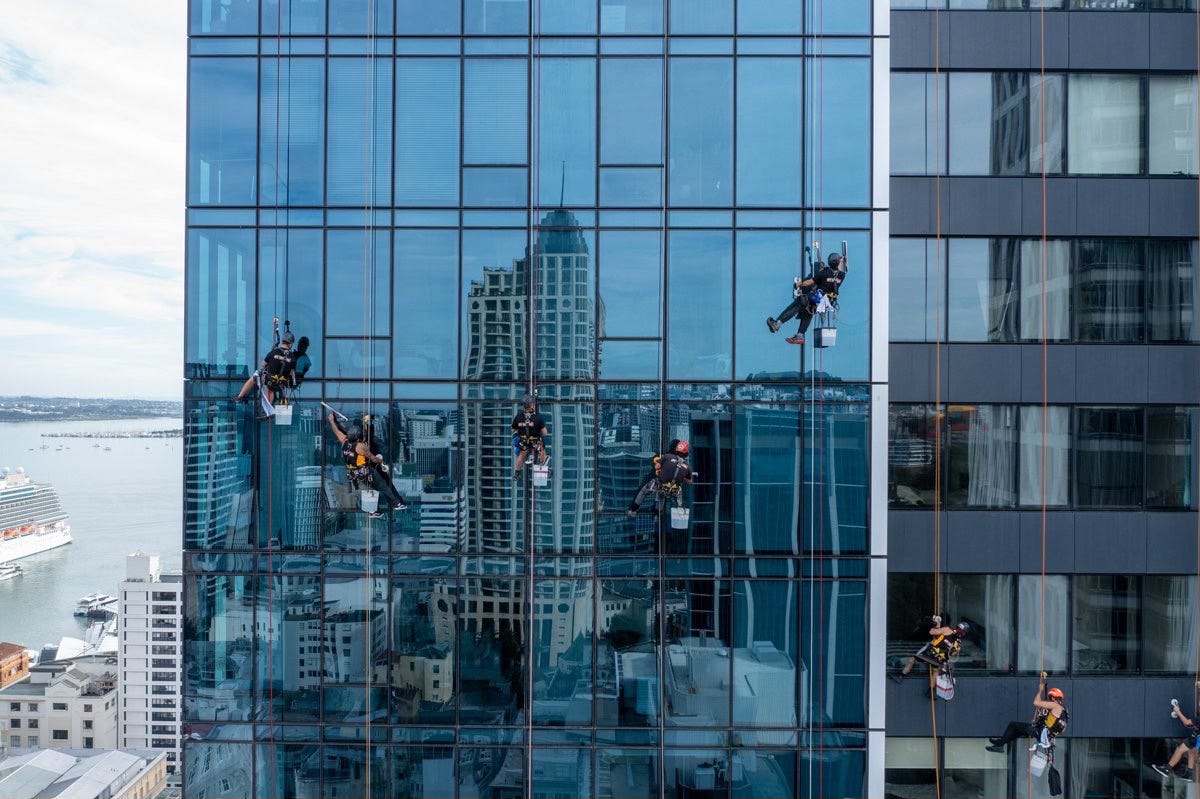
The most productive workers in the city are the abseilers cleaning windows.
They don’t hang about.
Let’s switch to ground level and see if things are happening there. Over at Britomart the old 1912 Edwardian baroque General Post Office building has been turned into a rail station. The process has been ongoing for eight years and trains have occasionally run in and out of it for the last four years. The flat yard out the back of the heritage building had been used for the delivery of materials, which finished around two years ago, and it has since been earmarked for a new public precinct for the enjoyment of all those people who will be transported to the heart of the vibrant city by the rail lines which will one day be completed.
I have watched the attempts to pave the area over the last two years with considerable interest. So, too, has my Indian friend who owns the adjacent dairy which, by default, has now become the city’s central post office. The entrance to his shop has become a maze of barriers that would rival the maze at Hampton Court. If you haven’t heard about the maze at Hampton Court it is because very few people have escaped it.
I chat with my Indian friend quite frequently and he tells me without fail that the ‘stunning’ new plaza will be completed in three months’ time. ‘Or by Christmas’, I always reply. I go there to send free books to critics. They used to go by ordinary post, but my friend advised me that they need to go by Post Office courier now, if I want them to arrive. The critics seldom read them, so I have a decision to make about that sometime before the money runs out.
The dairy is quite a big shop and it seems to be entirely filled with shelves stacked with the grocery category that is referred to as Confectionery and Snacks. It’s a massive category, with items branded with names beginning with the letter ‘T’ alone (Tootsies, Twinkies, Twizzlers, Treats etc) running into hundreds. Educationalists who say nobody can be taught anything anymore should take note of the working person’s ability to recall the thousands of brand names in the Confectionery and Snacks category. Those are minds capable of absorbing anything that interests them.
Productivity, it has to be said, is on every politician’s lips these days. It’s certainly on the National Party’s lips. That party, which I classify as being slightly to the left of the usual small-town parish of middle-aged Anglicans carrying liberal guilt and shame for the meanness of their welfare policies on their shoulders, has identified lack of productivity for the dire state of the economy. They’ve taken to harping about it endlessly, particularly on ZB’s Breakfast Show from 7:00 to 9:00 am of a morning, and the afternoon Drive Show between 4:00 and 7:00 pm at night. These are the times when everyone who goes to work in Auckland is sitting in a traffic jam.
New Zealand currently has 41 government departments with 82 ministerial portfolios being held by 28 ministers. Each of those ministers has two press secretaries whose job is to pepper news rooms with press releases showing how productive the minister is. These press releases are the building blocks for the newsroom staff for that day, whose first task is to find a trade union representative, or opposition spokesperson, to pour scorn on the content of the releases. It is a regular complaint of the radio hosts that they are unable to reach the press secretaries before 9:00am or after 4:00pm with follow-up enquiries because, of course, those are the times when they are sitting in traffic jams on their way to or from home. As a result, I am yet to hear any meaningful conclusion as to how productivity may be improved.
Today I looked out my window and saw that the traffic on the harbour bridge was moving at a snail’s pace. It was a bit windy, so AT had closed half the lanes, in memory of the high sided van that ran into a bridge piling some years ago, the driver claiming that ‘the wind did it’. I decided that it was time to bring my productivity study to an end. It simply wasn’t a productive use of my time.
A.I. Fabler
May 2, 2025
Nothing is different on either side of the world. Sounds like Philadelphia where I’m reading this. I never thought any city could out produce Philly.
Thanks for the chuckle. All true, even with the sight of a gannet.