

Is the clock TikToking for Substack?

A literary agent once almost lost her hair trying to persuade me that a social media presence is more important for an author than talent. At first glance her claim had merit. There are an awful lot of authors around, and very few of them have talent. There’s also an awful lot of social media around. Perhaps there was a connection.
To make her point, she sent me a 20-page closely typed set of instructions on how I must alter my daily routine. And, as if to make her argument irrefutable, she attached a list of writers of the moment whose book covers regularly carried the line “NY Times No.1 Best Seller”. How I hate that line.
So, I sighed deeply, took a heavy slug of whiskey, and dived into the Instagram site of a young English writer of the moment with an interesting Ionian surname and first name Michael. I stumbled into his life as if I were one of his college classmates that he hadn’t seen for a while and he was determined to assure me of how well he was doing. There he was in photo after photo, wearing a porcelain white smile and brown chest, with the Aegean Sea in the background and a rich man’s blonde wife opposite taking selfies.
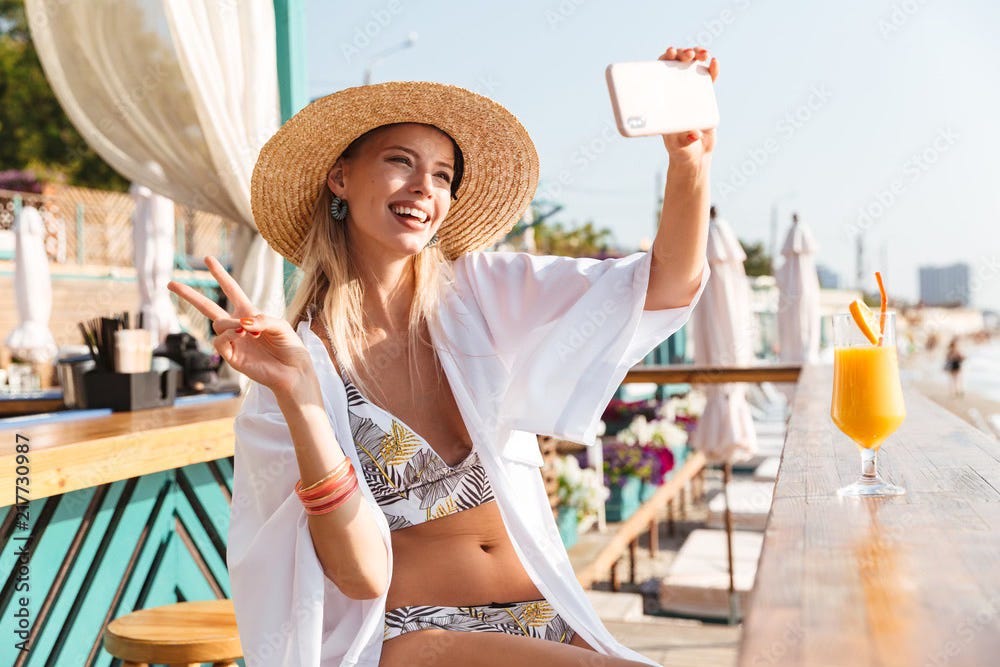
… with the Aegean Sea in the background and a rich man’s blonde wife opposite taking selfies.
“The beauty of Ancient Greece leaves me breathless,” was the caption. Was he being ironic, I wondered, or deliberately suggestive? After twenty or so similarly sunlit pics with an assortment of other young beaming, bronze chested young men, I concluded he was not referring to the blonde but was wanting to align himself with the Greek gods. “Oh, the ruins!” another caption read. “How much history they have to tell.”
I couldn’t wipe the sneer off my face, and then a new post came up before I was able to shut the site down. “Exciting news!” it shouted. “Simon and Schuster have won the bidding war for my next novel and it will be published in the Autumn. So happy and proud!!!” More bottles of Champagne, and more bare-chested boys posing in the Ionian sunset.
I exited quickly and went to the Facebook page of a woman who has apparently written a hundred (or is it a thousand?) NY Times No. 1 Best Sellers, and sold forty million (or is it eighty million?) copies. From the evidence of her postings, she has signed every one of those copies in every bookshop in the Midwest. When she comes to town, the hairdressing salons must run out of curlers responding to the requests for tints and perms. But, as one reviewer put it, “Her (name withheld out of courtesy) readers know their heroine will experience the heartbreaks, and the highs and lows that all women suffer, but in the end, they know that love will triumph.”
When, I wondered, do these people have time to write? And how could people idling their days away flipping through such endless banality ever bring themselves to turn off their iPhones and laptops long enough to actually read a book?
My agent had heard it all before. “Do what I say: sign up, get started, and post something every day,” she hissed between clenched teeth, before slamming the phone down (metaphorically). Then she sent me a text: “Hire an intern”.
A lovely young neighbour with a marketing degree said she could give a few hours a week and signed me up to Facebook, Instagram, Twitter and LinkedIn. I’d jot down a few bon mots whenever they came to mind, we’d brainstorm an image, and she’d do the rest. “No pictures of meals,” I insisted. “Or cute cats and dogs. Or holiday beaches with white people trying to turn themselves brown. And no exclamation marks or emojis.”
It was doomed from the start. My bon mots needed to be smart, I told myself. To be smart, they needed thought. Thought was time consuming, and not always successful. What was worse; no-one liked them or bothered to comment. My nice young neighbour was not surprised when I admitted defeat. We agreed to remain friends and I tried to shut my sites down. (You can’t. They handcuff you to them forever.) My writing output immediately soared.
Then, along came Substack. I was introduced to it through the writing of Bari Weiss. She was a columnist, or editor, at the NY Times who was deplatformed following a hate attack by woke cretins on the newspaper’s staff, for the sin of not toeing the tribe’s line. Bari and her wife Nellie said f- you and started an online news and opinion letter called The Free Press. They chose Substack as the platform, as it was attracting long form journalism by independent writers, free of editorial interference: those who corporate media considered a danger, mainly because they asked unwelcome questions and reached unwelcome conclusions.
The Free Press, in particular, took off. It attracted other great writers as contributors and over 750,000 subscribers. Substack itself now has tens of millions of subscribers, including over four million paid subscribers to its many independent writers. Apart from Bari (who I love — platonically) I believe it has some of the best essayists and investigative journalists in the English language among its contributors. They created an environment in which I wanted to quietly express my thoughts now and then. Hence this column. From the depths of immersion in the daily plotting of a fictional world, for me as a novelist, the opportunity to take a break once a week and comment on the world’s absurdities is like a holiday.
There are some notable names here, and I’ll mention a few. Douglas Murray who I also read in The Spectator. His moral and physical courage in facing down evil is sanitising. Always erudite and articulate, he has now become ubiquitous. Ayaan Hirsi Ali, also a fearless defender of good against evil, and her husband (the lucky bastard) Niall Ferguson, who makes history a living ingredient of the present. And Kat Rosenfield, the best young essayist you’ll find anywhere.
Elsewhere there’s Michael Shellenberger on Public, who will not rest until those cynical quislings in the intelligence community are defrocked and put in the stocks. Konstantin Kirin, for his Russian lack of self-delusion and realistic view of what to expect from a world captured by the so-called elite — not to mention Islam — is never dull.
Dr Robert Malone is the sort of enemy that Big Pharma and Health Agencies deserve, and that every Covid enquiry should call as their first witness. But they won’t. I signed up in the first week to the Great Barrington Declaration during the early days of Covid and have followed Malone and his Brownstone Institute colleagues ever since. If you want to regain trust in science, go follow.
There isn’t time to read everyone worth following, but Substack allows us to cancel the newspaper, turn off the TV and Channel “news”, and dip in and out of invigorating discussion as time allows. Except ...
Substack is now under threat. It started when they created a cell phone app, and introduced a new content medium called Notes. The idea was that Notes could guide readers to long form pieces by providing a short form promo, and a teaser pic. You’d get a ping on your phone to tell you that a Note had been posted featuring a writer that you followed. It was overkill. If you subscribed to a writer, the long form version was going to arrive in your email box regardless.
But Notes was quick and easy. It could be stand-alone. No long form work was required. So, pretty quickly, everyone who wanted Likes for the most vacuous content they could load onto the app was taking video clips of cats and lovable dogs, trashy people making fools of themselves, and black bears caught on dashcams wandering down the highway in Dakota. Fridge door quotes by long-dead writers were framed in portentous borders and presented as if they reflected the depth of intellect and wide reading of the person posting them.
Now we have influencers showing us how to apply mascara and make their tits as big as Kylie Jenner’s. Square jawed men in Stetson hats look seriously into the camera like Marlborough Man without a cigarette, and tell us Elon Musk don’t know nothin’ from horse shit.
OMG, as they say on TikTok. How do we get rid of this thing? Do we need a proof of age, excluding anyone under thirty-five? What about an IQ test before you can join? It could involve a longish sentence containing three clauses and four facts, followed by multiple choice questions aimed at identifying those facts.
Okay, maybe that’s a bit hard. Here’s an idea. How about Substack creates an AI search engine that scrapes Instagram, Facebook, TikTok and Bluesky, and identifies anyone who has a presence there and tries to get on Substack? Maybe ask Grok or OpenAI to give a hand.
Or, better still, close the damn thing down.
A.I. Fabler
July 11. 2025
Thanks Lanceus. I'll take a look. AIF
The situation seems a little like that of classical music: if record companies make a lot of money out of pop and use a tiny part of it to subsidise the stuff that a minority like me enjoy then so be it. It keeps some of our Western cultural triumphs going in the face of modern philistinism.
Substack readers are perfectly capable of deciding for themselves.